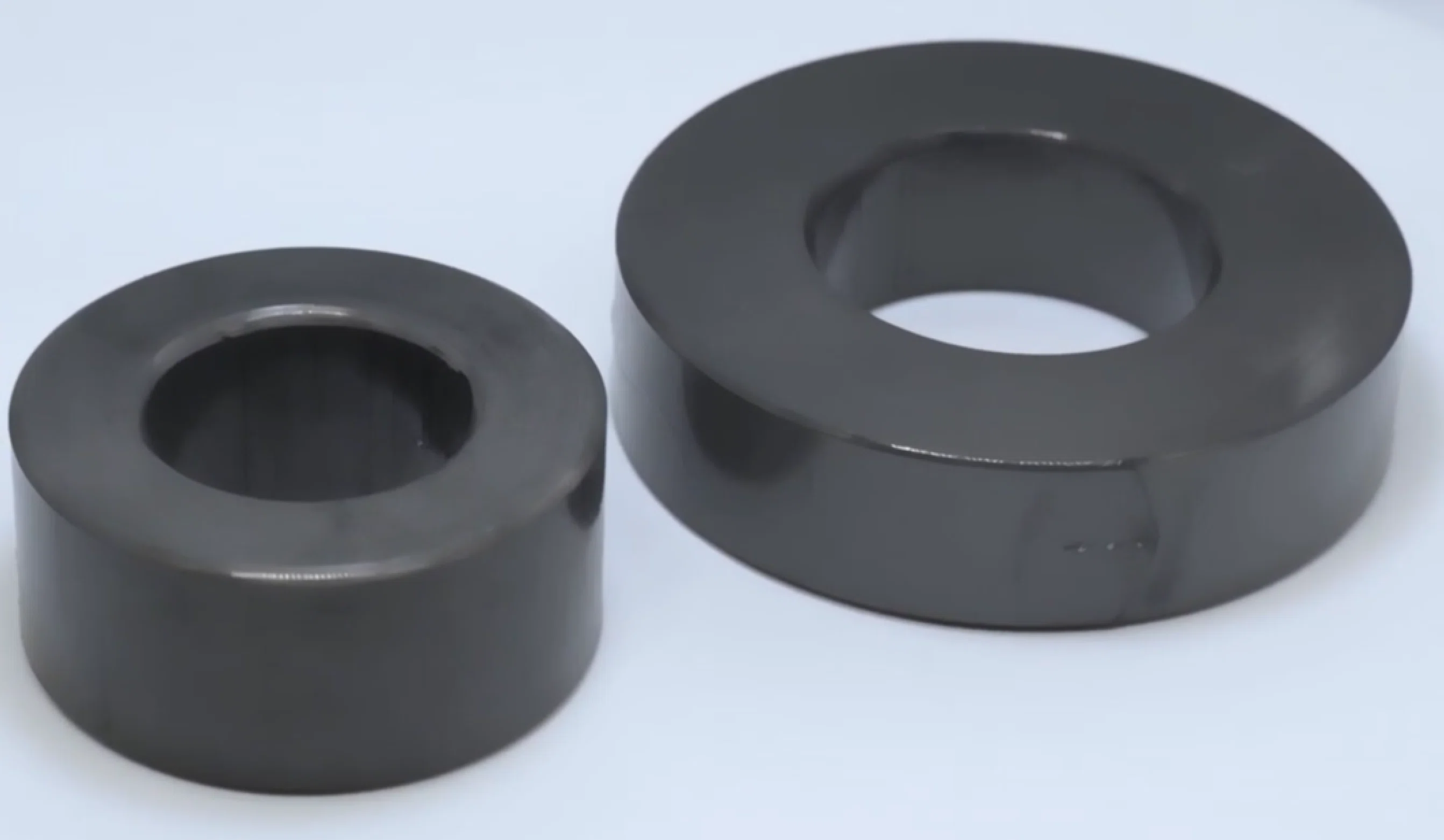
Toroidal core size chart: how OD, ID and height define the core
A toroidal core is defined by outer diameter, inner diameter and height, which together set the mean path length and the cross-section area — and therefore AL and inductance. To reach a target inductance, either increase AL (bigger core or higher permeability) or increase turns.
The three dimensions
OD — outer diameter, sets the maximum winding envelope.
ID — inner diameter, limits how many turns fit.
HT — height, adds cross-section without increasing OD.
Ae (effective area) ≈ (OD − ID)/2 × HT; le (mean path) ≈ π × (OD + ID)/2.
From dimensions to inductance
L = AL × N². If you know the core material and dimensions, the supplier should give AL (nH/N²).
For a gapped or cut core, AL depends strongly on the gap — always ask for AL at the intended gap.
Increasing turns by 10% raises inductance by 21%, but also raises copper loss and window usage.
Sizing rules of thumb
Choose ID at least 1.5× the total winding bundle thickness to keep winding feasible.
For 50/60 Hz power cores, size by flux density (keep Bmax below 1.7 T), not by inductance.
For high-frequency nanocrystalline cores, size by loss and temperature rise.
FAQ
Can I stack two identical cores to double AL?
Yes, roughly — stacking doubles Ae and therefore doubles AL, as long as the cores are in good contact and the winding covers both.
Does coating reduce the window?
Yes, epoxy coating (0.2–0.5 mm) reduces both OD and ID slightly. Account for it when calculating turns per layer.