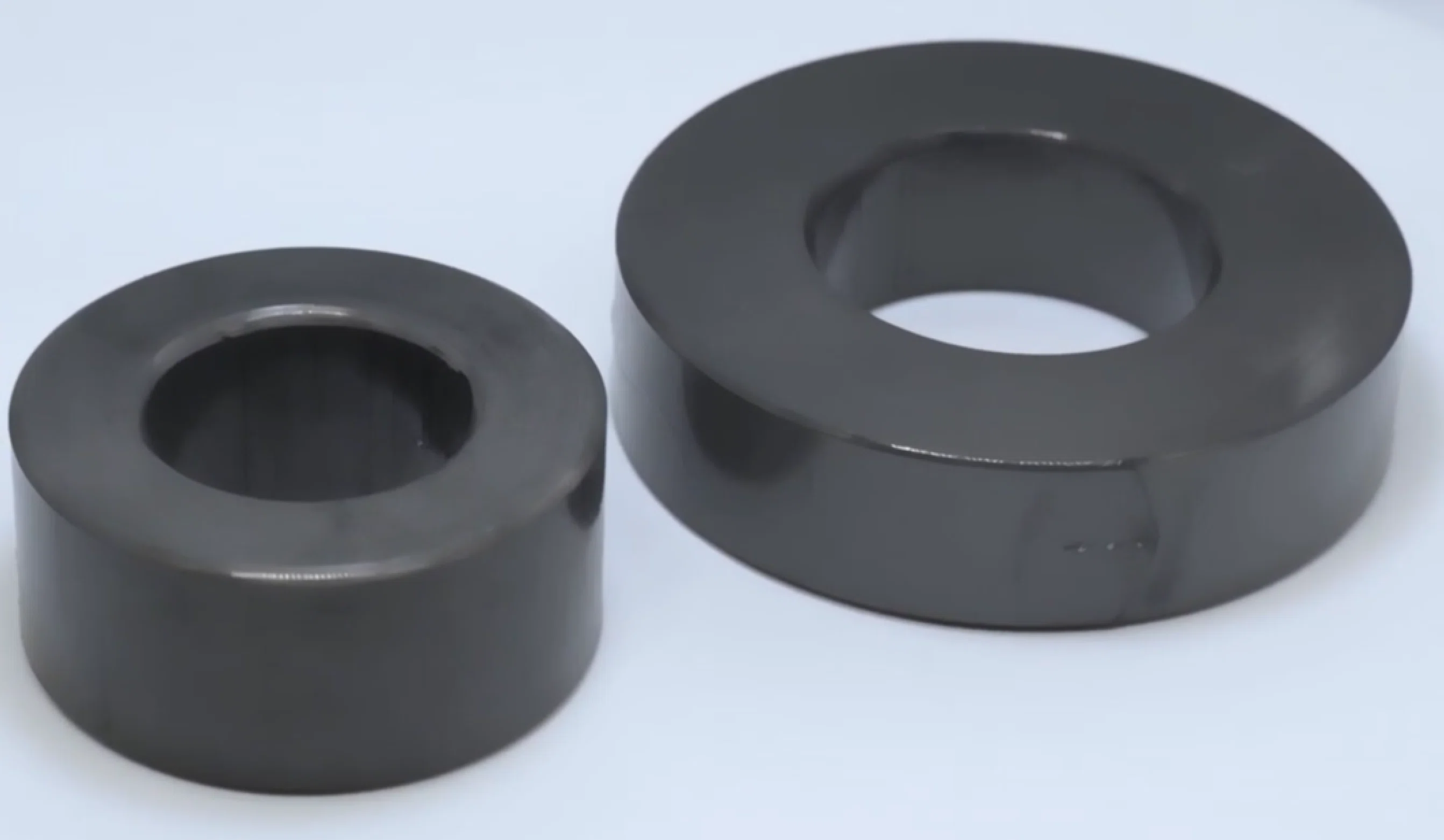
Nanocrystalline vs amorphous cores: which one should you choose?
Choose nanocrystalline when you need the highest permeability and lowest loss in a small core (CTs, RCDs, high-frequency transformers, EMI chokes). Choose amorphous when you need higher saturation flux density than ferrite at moderate cost and can accept lower permeability and brittleness.
Key differences at a glance
Saturation flux density: amorphous ≈ 1.56 T, nanocrystalline ≈ 1.2 T — higher Bs means more DC bias capability.
Permeability: nanocrystalline µi can reach 80,000–120,000; amorphous is typically 1,000–10,000.
Core loss: nanocrystalline is lower, especially from 10 kHz upward.
Cost: nanocrystalline ribbon costs more per kg; amorphous is cheaper but harder to cut cleanly.
Where nanocrystalline wins
Instrument and current transformers where phase error must be small.
Residual current devices and smart meters that sense very small currents.
High-frequency transformers and resonant inductors in EV chargers, solar inverters and welders.
Common-mode chokes where impedance per volume matters.
Where amorphous wins
Distribution transformers where no-load loss matters and Bs must stay high.
Applications with strong DC bias where 1.56 T helps.
Cost-sensitive designs that can tolerate lower permeability.
Manufacturing considerations
Amorphous ribbon is brittle: cutting and handling create micro-cracks that raise loss, so expect tighter process control and more scrap.
Both materials need stress-relief annealing after cutting; nanocrystalline is more sensitive to annealing atmosphere.
Epoxy coating is recommended for both to protect edges and provide winding insulation.
FAQ
Can amorphous replace nanocrystalline in a CT?
Usually not for class 0.2S/0.5S — amorphous permeability is too low, giving larger phase error in the same volume.
Which is better at 50 Hz?
At 50 Hz the loss difference narrows; amorphous is often chosen for distribution transformers because of higher Bs and lower cost per kVA of no-load loss.