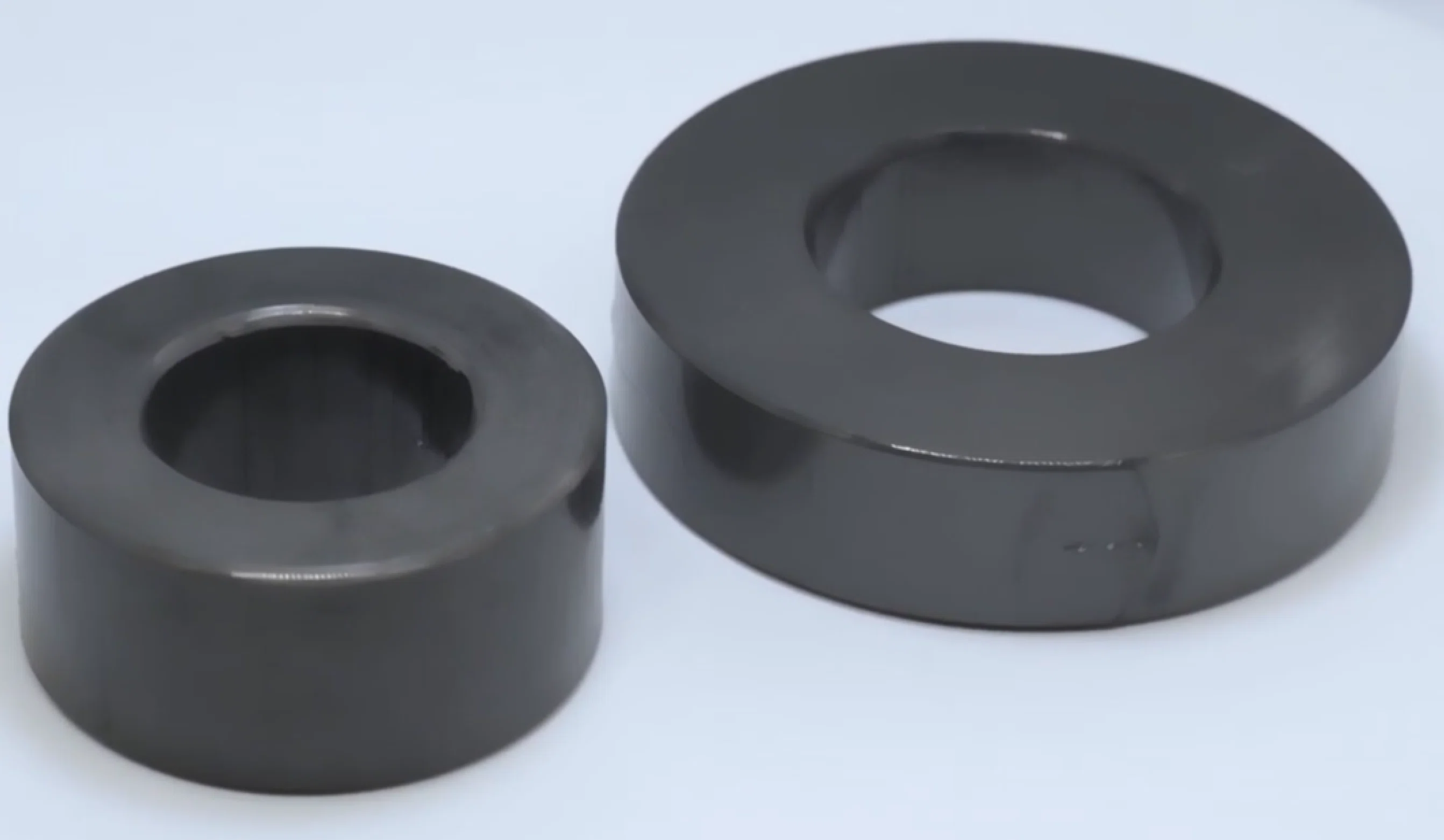
Silicon steel vs nanocrystalline vs ferrite vs amorphous: which core material?
Choose by frequency and flux first: silicon steel for 50/60 Hz power transformers, nanocrystalline for 10 kHz–100 kHz where low loss matters, ferrite for 100 kHz–MHz, and amorphous when you need lower no-load loss than silicon steel at mains frequency.
Comparison at a glance
Silicon steel (GOES): Bs ≈ 2.0 T, thickness 0.23–0.35 mm, loss 0.9–1.3 W/kg at 1.7 T/50 Hz, lowest cost per kg.
Nanocrystalline (1K107): Bs ≈ 1.2 T, 18–30 µm, µi up to 100k, lowest loss above 10 kHz, higher cost.
Amorphous (2605SA1): Bs ≈ 1.56 T, 25 µm, no-load loss ~60–70% lower than GOES, brittle, higher cost.
Ferrite (MnZn/NiZn): Bs ≈ 0.4–0.5 T, works from 100 kHz to hundreds of MHz, very low cost at high frequency.
Frequency decides more than price
Above roughly 10 kHz, eddy-current loss in thick steel dominates; nanocrystalline or ferrite is the only sensible choice. At 50 Hz, ferrite would need an impractically large core.
Cost vs total cost
Per kilogram, ferrite < silicon steel < amorphous < nanocrystalline. But efficiency, size and copper savings often reverse the ranking over the product life.
FAQ
Can nanocrystalline replace silicon steel at 50 Hz?
Technically yes, but at mains frequency the efficiency gain is small relative to the cost increase — silicon steel is usually the better economic choice.
Which material for an EMI choke?
Nanocrystalline for 10 kHz–1 MHz, MnZn ferrite for 100 kHz–1 MHz at lower cost, NiZn for 1–500 MHz.